Showing posts with label Blood & Treasure. Show all posts

Wednesday, 23 November 2022

Firearms in D&D Part 3: Getting Old School

So, in the first part, we discussed what issues we need to consider when adding black powder weapons to a D&D-derived fantasy world.

In the second, we checked out D&D and Pathfinder's current iterations of firearms to see if we could steal anything fun.

In this one, we will delve into the dark, murky and sometimes controversial world of the OSR to see what we can glean.

Starting with a personal favourite, Small But Viscous Dog - the rotten lovechild of B/X and WFRP.

Firearms are fairly deadly (as befits a WFRP-alike). They ignore armour at close range, which is more difficult to model in games where you fight monsters. They also have high damage dice, which can be a swingy way of representing the damage of firearms.

I had considered ignoring armour, but as the game is a swashbuckling pirate game, most people won't be wearing armour at all, so it's a bit of a moot point. I would like armour to be something worth using, so I will keep AC against firearm attacks. Makes more sense to me, at least.

AD&D 2e had the famous "Green Books" - the Historical Reference collection. We are interested in A Mighty Fortress, which covered the Elizabethan Age (and a bit after that as well). As with most things AD&D, there are a collection of awkward, exception-based rules for firearms which make them somewhat difficult to track on the tabletop.

At close range, firearms once again ignore armour; at medium range, the target's AC is penalised by 5, and at long range AC is penalised by 2. There are very loose rules for cover (i.e. it must be more "substantial" to qualify for the cover bonus; no rules are given past that. These firearms also given exploding damage dice, which is a fun idea and a good way to represent the inherent deadliness of firearms.

There are also rules for misfires, hang fire, fouled weapons from excessive use and point-blank firing. It's fairly extensive, but feels like it might bog down the game.

I can see allowing exploding damage die for crits with firearms, rather than simple double damage; that could be a fun little wrinkle. Otherwise, the other rules feel a bit excessive, and I don't mind combining fouling, hang fire and misfires into the fiction of rolling a natural 1.

The ladies of LotFP, preparing for a fight
The Ladies of LotFP, Preparing For a Fight!
Lamentations of the Flame Princess is another Black Powder Fantasy game, of sorts. I wouldn't recommend spending money on these rules, for a number of reasons, but luckily they are free!

As part of the Early Modern setting that became part of the game as it developed, LotFP includes pistols, muskets and arquebuses, in matchlock, wheellock and flintlock varieties. It even has rules for rifling!

Again, firearms ignore armour at close range. 

This brings the idea as to what sort of firearms I want present. I like the idea of having all three firing mechanisms present; it's a little bit anachronistic, but I like having the option of some areas being underequipped, while some are able to afford much nicer weapons. You can find small smithies cranking out simple arquebus-style guns, but if you want a proper rifle, you need to find a professional gunsmith.

We'll end on Adventurer Conqueror King (ACKS). Now, I generally don't recommend the system - the author is not only kind of a shitty dude, but he also supports a lot of other shitty dudes. It's also obsessed with minutiae and detail, in a way that isn't as much fun as it thinks it is, and the rules aren't free in any respect.

If you really want to read ACKS, my advice would be to read what sort of game this is for and act accordingly. Yo ho!

ACKS has the Guns of War supplement, which feels very similar to LotFP's (no doubt a result of using the same historical basis of the Pike & Shotte era). All firearms do 1d8 damage, pistols have ranges of 25ft/50ft/100ft, while rifles are 50/100/200. Weapons have detailed time to reload (for both trained and untrained soldiers), with bonuses to reload times for high Dexterity, penalties for being over burdened, items to reduce the loading time, several types of ammunition...

It's just a bit much, honestly. There's nothing here that wasn't covered elsewhere, better.

Wednesday, 10 August 2022

Firearms in D&D Part 2: What's Already Out There?

In the first part of this series, I looked at why guns were such game changers, and how that might be represented on the tabletop. This time, we'll be looking at what the bigger fantasy games have done with black powder weapons.

As I am using Blood & Treasure as my base for the game, it makes sense to look at there first.

In B&T, black powder weapons are designed with higher damage in mind - each has a +1 to their dice, making them slightly more lethal than bows (the game does the same for crossbows). In exchange, guns have a much shorter range than bows; in practical terms, most fights won't take place over long enough distances for range bands to matter all that much in most games.

For a pirate game, they might matter if someone is trying to shoot from one ship to another, but that's why you have cannons!

Both firearms and crossbows have a Reload score; to reload one of these weapons, you need to roll under this chance in 6 to reload the weapon in that round (for instance, a hand crossbow has a 3 in 6 Reload, while a musket is 1 in 6). This offers a good balance between semi-auto flintlocks and being completely unable to reload in a fight, but can lead to frustration when reloading is up to the dice. Indeed, it should encourage the classic "brace of pistols", wearing three or four pistols to prevent needing to reload during a fight, but give some tension to those "last shot, better make it count" sort of fights.

I might alter this so your Reload rate increases by 1 each round, making it more and more likely that you will succeed. So, a Reload of 1-in-6 becomes 2-in-6 after a failed roll, then 3-in-6 and so on. At a rough guess, average reload times will go up by a round or two. Might need to do some math to work out how that changes things. This might make things more fast-paced, and less is needed to balance guns when everyone has them. 

These are a few mechanics that interact with firearms - notably, some subclass options that increase your Reload rate, and even a 1% chance of getting a magical gunpowder weapon in a random treasure hoard. It doesn't have any specific magic firearms or ammo, which is a bit of a missed opportunity.

There's also Pathfinder's take on firearms, which I covered in my original post on this topic (almost a decade ago, Christ).

Does Pathfinder give you combat bonuses for being absolutely covered in random shit?

To look at Pathfinder 2e, we can see that things have changed quite a bit. Guns no longer cost a king's ransom (1000gp for a flintlock pistol? Now down to 6gp), and the mechanics have morphed into their own sort of divergent 5e-esque form. While I can't lift most of the mechanics from 2e, one idea I really love is Beast Guns.

Building weapons out of monster parts, like in Monster Hunter, is always cool as shit. I would happily convert the idea over; maybe allow these parts to be used to make unique magical weapons and items. Blood & Treasure already has a more involved system for making magic items, where monster parts can easily be used in conjunction with other ingredients (so long as you know someone able to make magic items). It might also give a mechanical difference between magic weapons and magic firearms, as if magic hasn't caught up to technology, so you need to use a more directly magical thing to get it to work.

Over in 5e land, there are two black powder weapons available; pistols and muskets. For 250/500gp, you can net yourself a 1d10/1d12 ranged weapon, with decent range, and the Loading tag (and Two-Handed for the musket). It's effectively a slightly better crossbow, that costs 5 times as much. Not the best representation, with nothing to really set them apart from other weapons (it feels like 5e really dropped the ball with its weapon tags).

So, not a lot to really pull from in the Big Two, but next time we will start peeling through other OSR games for some more ideas!


Monday, 1 August 2022

Firearms in D&D - What's the Deal?

So, this is a topic I have covered before on this blog. But, as I come towards working more on my Pirate Saltbox game, I am back to researching alternatives that help capture the "sword and pistol" mode that a real Pirates game requires.

So - why were firearms so revolutionary? Well, there's a few points to consider.

  • Ease of use - even the most basic firearms can be considered "point and shoot". Bows require strength to pull back, adjusting for wind and arcs over distance, and longbows compound both those factors - King Edward III supposedly said "If you want to train a longbowman, start with his grandfather". You needed the right height and build to have a chance at using it correctly. But anyone can point a stick and pull a trigger, even a peasant. They weren't as accurate as a trained bowman, but when you could field so many easily-replaceable troops, who cares?
  • Penetrating Power - warfare always results in a arms race, particularly between weapons and armour. Firearms managed to overtake armour in a way that made almost anything short of steel plate completely useless (yeah, D&D's full plate armour? That was made as a reaction to firearms). Seeing as the rank and file couldn't be fully decked out in half-inch thick steel, most stuck to simpler cloth armour. Even then, they found that bullets would tear pieces of clothing and force it into their wounds, resulting in serious infections that were more likely to kill you than being shot. So, firearms were either deadly in the moment, deadly a few days later, or incredibly dangerous and disabling if you were lucky.
  • Scalability - you can only make a sword so big. Firearms started as cannon, and advances in one area could be backported to the other fairly easily. Indeed, you could make cannons big enough to destroy castle walls, leading to yet another arms race that ended with the star fort
  • Unintentional Advances - firearms also pushed new advances in metalwork and engineering, making them part of a larger set of developments that drove technology forward. Black Powder could be used for firearms, explosives, and many other applications. .
Now, how do we go about representing these in a game? There are a few options, some of which work better than others.

First off, ease of use. This one is easy to model - everyone who can use a sword can use a gun. I would say Fighters, Rangers, Paladins and Barbarians are all fair for using them, Wizards and Clerics not so much, though they along with Thieves and Bards *might* be limited to pistols; I can see it going either way.

This is for adventurers, of course - many of the knightly classes saw firearms as dishonourable (anything that lets those stinking peasants be equal to their betters must be bad, right?), and most of the lower class wouldn't have access to firearms outside of military service. Of course, many would abscond with a few choice pieces for use when money is a little tight, setting themselves up as highwaymen. Many places did not require licenses or anything of the sort to own firearms, meaning they could easily spread through trade and barter.

For penetrating power, there are a few options. Reducing AC, high damage, forcing saves... all of them are a bit fiddly in practice. Indeed, one set of rules that would give firearms their due is the AD&D Weapon Speed Factors and differing Damage vs Armour Type. 

Firearms should be roughly the same SF as crossbows (time to lift, aim, etc), maybe a point or two faster to balance out the longer reloads, and should have something to represent their penetrating power (maybe +1 vs light armour, +2 vs medium and +3 vs heavy armour - armour always has a chance to help stop it, but in most cases it will blow straight through, with half-plate and full-plate being the best possible protection but not total protection).

But seriously, ain't nobody got time for that.

As for scalability and other advances, those I can work into the background as I develop the setting more.

Next time, I will go through some of the options laid out in other games, to see what appeals and what might work.

Tuesday, 8 March 2022

Blood & Treasure - The Artillerist and Topkick Classes

So, I am working on my Pirate Hack for Blood & Treasure, to use with the setting I am making with the Gygax 75 Challenge. Part of that is tweaking a few classes, such as turning the Barbarian into the Reaver (the battle-mad front line of a good ship raid), or turning the NOD Companion's Curmudgeon class into the Old Salt (for NPCs who have been around the block a few times, or for a slightly different player choice).

The two I am adding are the Artillerist and the Topkick.

THE ARTILLERIST

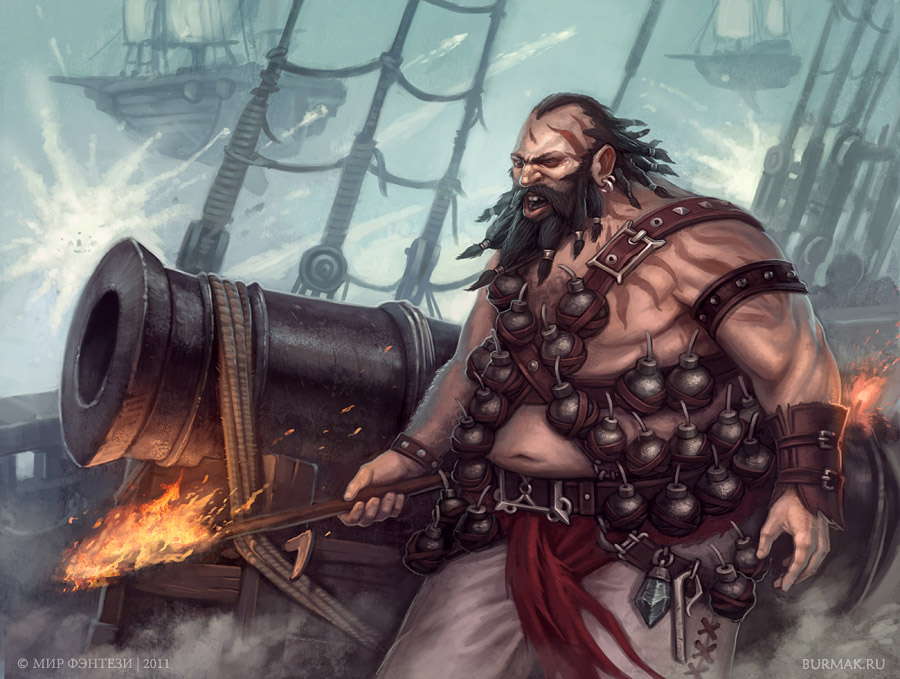
Cannoneer by DevBurmak

Requirements - Intelligence and Dexterity 9+

Armour Allowed - Padded, leather, ring mail, scale mail, tower shield/pavises

Weapons Allowed - All black powder and siege weapons, club, dagger, mace, polearms, shortsword, sling

Skills - Bend Bars, Break Down Doors, Engineering, Move Silently, Riding

Black powder isn't exactly new, but it is the cutting edge of technology. The Artillerist rides that edge, a master alchemist and pyromaniac extraordinaire. While they can fight, they prefer to hang back, using their fancy new weapons whenever possible.

When using black powder weapons, the Artillerist reduces their reload time to 4/6, or 1 round when using pistols. They can also use weapons which require a staff or support without one.

Masters of black powder and alchemy, the Artillerist can concoct small explosives in their downtime. Each takes 10 minutes to make, and the artillerist suffers no chance of failure (basic or explosive!) when making them.

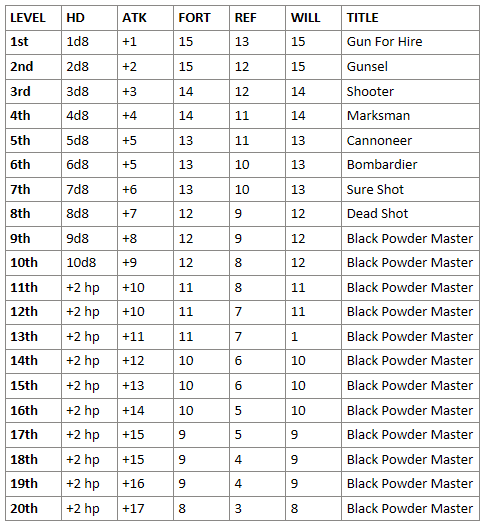
A 1st Level Artillerist can concoct normal explosives that become more powerful as they increase in level, and can create different concoctions as the table below;


All these bombs have a blast radius of 5 feet, or as their listed spell. An Artillerist can sacrifice one dice of damage to increase the radius by 10ft.

At 5th level, the Artillerist counts as two people when operating any siege or artillery weapons, and can reroll any artillery or thrown weapon scatter dice.

At 9th level, the Artillerist can open a Gunnery School, teaching the arts of black powder. They attract 1d6 men-at-arms per level, 1d6 1st level artillerists who wish to train under them, and a 3rd level artillerist to act as a lieutenant/deputy headmaster.


The Topkick is a master of small-unit tactics; the one leading boats on shore missions, or groups to infiltrate a coastal fort to bring it down from the inside. Similar to a Captain being in charge for shipboard battles, the Topkick is the absolute authority on his missions. This does not mean he cannot be questioned, but simply that his fellows trust his word when it comes to tactics.

This version of the Topkick is heavily lifted from A Wizard's Kiss, who did a version of the Warlord for OSR games. While he hasn't updated for a while, his blog is full of cool stuff - go have a look!

THE TOPKICK

Captain Flint is a Topkick for sure
Requirements - Intelligence and Charisma 13+, Strength 9+

Armour Allowed - All

Weapons Allowed - All

Skills - Communication, Politicking, Riding

Topkicks demand absolute dedication from their allies in battle. This doesn't mean the other players have to obey everything the Topkick tells them to do, it just means that when the Topkick says jump, your character trusts him enough to know that there must be a knee-high buzzsaw approaching or suchlike.

To establish this trust, the Topkick must spend ten minutes talking to any new party members. There cannot be more than one Topkick in a party - if there are, then their orders confuse each other and the Topkicks' abilities are all negated. The Topkick cannot command a group of people larger than the Topkick's Charisma score (until 9th level - see below.)

Topkicks can spend a standard action to use a Command, which is a catch-all term for various speeches, orders, battle-cries, etc. that have the power to turn the tide of battle. The Topkick can use one Command per level per encounter - the focus required for this sort of tactical thinking and charismatic oration is very mentally draining.

Commands only work on allies who are conscious and can understand the Topkick. They also need to be within 30' or the command is too faint or garbled to be heard.

Pick one Command at 1st level and one other at each odd-numbered level thereafter:

Encouraging Command: The Topkick and any allies under their command gain +1 to their side's Initiative rolls. 6th Level: +2 to initiative rolls.

Defensive Command: The Topkick can gather their allies into a shield wall - if three or more are together and armed with shield, they can an extra +1 AC, and provide cover to anyone behind them. 6th Level: gain +2 AC in the shield wall.

Invigorating Command: The Topkick inspires one ally to fight on through the pain, giving them 1d6 temporary hit points (last until the end of the encounter or 1 turn). 6th Level: 1d6+level hitpoints, and if the ally is unconscious, you can use this to slap them awake.

Inspiring Command: The Topkick brings one ally back from the brink of terror and defeat, allowing them to reroll a failed morale check or saving throw vs. fear. This command can be used as a reaction (i.e. on the turn of the person failing the save or morale check.) 6th level: Can grant all allies a rerolled morale check, OR grant one ally a rerolled save against domination, confusion, or other mental effects.

Warning Command: The Topkick warns one ally of an incoming attack, granting them a +4 bonus to AC for one round against the next attack from a designated enemy. 6th level: The Topkick predicts every attack just before it happens, granting the bonus against all incoming attacks in the next round.

Analysing Command: The Topkick points out a weak spot in the enemy's armour or their posture, allowing one ally to gain a +2 bonus to hit and damage against that enemy on their next attack. 6th level: All allies gain the bonus against that enemy for one round.

Tactical Command: The Topkick sees an opening in the flow of battle and orders one ally into it, granting them an extra action. 6th level: This Command, and the extra action it grants, can be used before initiative is rolled.

At 9th level, the Topkick gains the ability to command an army of up to 100 soldiers per level, or one ship per level. Everyone in the army is considered to be an ally for the purposes of Commands, though the effects will still be limited by the 30' radius. Furthermore, the Topkick's Commands can now also be used as Gambits - essentially the same thing but on a Naval scale. For example, a Tactical Gambit could be used to steal a ship into an enemy formation, an Analysing Gambit could maneuver a ship into position to flank, etc. DM fiat/negotiation will be required here, as it isn't a perfect fit with the Freebooters Naval Combat rules, but I am sure I can make it work!

Monday, 1 August 2016

The Isle of Dread - Remix Edition Part 1

So, my previous game has ground to a halt due to grown-up issues, so I'm going to try and get everyone back together, or replace those who can't continue, with a better schedule and a new campaign.

And what better way to start a new campaign than the Isle of Dread?

I do plan on changing things up a bit, and injecting a little weird into the game. After all, the module is left fairly open with regards to what's really going on - one of the best things about older modules, in my opinion. That level of openness and hackability makes it way easier to make the whole thing fit into your world, rather than modern modules where you lift encounters or basic plots and have to leave the rest.

I'll be using Blood & Treasure for the game, for a nice combo of new-school ideas and old-school charm.

For a start, let's make the Kopru more interesting AND give them a little more foreshadowing than "bad things on Taboo Island!"

Sunday, 31 July 2016

The Order of Nemesis

Image from Paizo
Paladins are holy warriors. The lead the charge against the enemies of their God, pushing back the grand forces of Chaos and Evil to the edges of civilisation, hoping one day to wipe it out entirely.

They are shining beacons of righteousness and hope to all.

Except the little people.

When the Paladins stroll through town, they ask about demonic invasions, Orc warband movements, or the doings of the Evil Overlord next door. While dealing with Capital Letter Chaos and Evil, they rarely have the time to ask about corrupt landlords, abusive spouses, or uncaring madams, and even if they do, they simply dont care about these minor doings in the grand scheme of Evil.

But The Order of Nemesis cares.

Dedicated to an ancient Goddess (Nemesis, Lady Vengeance, She), considered heretical by most of the faiths of the land, The Order is made up of those who will not stand by and watch the innocent suffer. Recruited from the lowest rungs of society to protect those who can't protect themselves, they are the Grey Guardians of many a city - even if their presence is passed off as simply superstition.

Recruits are taken from those who are wronged and wish for only one thing - revenge. Once She hears their prayers, they awaken one day with an oily, grey dagger under their pillow, and a message in their hearts.

Go seek your vengeance, my Child.

If they go through their retribution, they are inducted into The Order soon after, donning no uniform bar a grey cloak and their dagger.

The Order of Nemesis always has its ear to the ground - seeking out corruption and evil in the lowest parts of society, and providing revenge for those who cannot seek it themselves. They can make excellent allies, willing to share information to take down a high-priority target, or fierce enemies if you managed to wrong someone under their protection.

Order of Nemesis Code of Honour

  • Protect those who cannot protect themselves
  • The lowest of Men deserve the same as any other
  • Any crime against the weak must be avenged
  • No man is beyond Her reach - not even Her Children
  • Forgiveness is weakness
In game terms, the Order is made up of Assassins. In systems where Assassins gain spells, they may choose spells from either the Assassin or Paladin spell lists. While they have to be at least Lawful, most are Lawful Evil.