Wednesday, 23 November 2022

Firearms in D&D Part 3: Getting Old School

So, in the first part, we discussed what issues we need to consider when adding black powder weapons to a D&D-derived fantasy world.

In the second, we checked out D&D and Pathfinder's current iterations of firearms to see if we could steal anything fun.

In this one, we will delve into the dark, murky and sometimes controversial world of the OSR to see what we can glean.

Starting with a personal favourite, Small But Viscous Dog - the rotten lovechild of B/X and WFRP.

Firearms are fairly deadly (as befits a WFRP-alike). They ignore armour at close range, which is more difficult to model in games where you fight monsters. They also have high damage dice, which can be a swingy way of representing the damage of firearms.

I had considered ignoring armour, but as the game is a swashbuckling pirate game, most people won't be wearing armour at all, so it's a bit of a moot point. I would like armour to be something worth using, so I will keep AC against firearm attacks. Makes more sense to me, at least.

AD&D 2e had the famous "Green Books" - the Historical Reference collection. We are interested in A Mighty Fortress, which covered the Elizabethan Age (and a bit after that as well). As with most things AD&D, there are a collection of awkward, exception-based rules for firearms which make them somewhat difficult to track on the tabletop.

At close range, firearms once again ignore armour; at medium range, the target's AC is penalised by 5, and at long range AC is penalised by 2. There are very loose rules for cover (i.e. it must be more "substantial" to qualify for the cover bonus; no rules are given past that. These firearms also given exploding damage dice, which is a fun idea and a good way to represent the inherent deadliness of firearms.

There are also rules for misfires, hang fire, fouled weapons from excessive use and point-blank firing. It's fairly extensive, but feels like it might bog down the game.

I can see allowing exploding damage die for crits with firearms, rather than simple double damage; that could be a fun little wrinkle. Otherwise, the other rules feel a bit excessive, and I don't mind combining fouling, hang fire and misfires into the fiction of rolling a natural 1.

The ladies of LotFP, preparing for a fight
The Ladies of LotFP, Preparing For a Fight!
Lamentations of the Flame Princess is another Black Powder Fantasy game, of sorts. I wouldn't recommend spending money on these rules, for a number of reasons, but luckily they are free!

As part of the Early Modern setting that became part of the game as it developed, LotFP includes pistols, muskets and arquebuses, in matchlock, wheellock and flintlock varieties. It even has rules for rifling!

Again, firearms ignore armour at close range. 

This brings the idea as to what sort of firearms I want present. I like the idea of having all three firing mechanisms present; it's a little bit anachronistic, but I like having the option of some areas being underequipped, while some are able to afford much nicer weapons. You can find small smithies cranking out simple arquebus-style guns, but if you want a proper rifle, you need to find a professional gunsmith.

We'll end on Adventurer Conqueror King (ACKS). Now, I generally don't recommend the system - the author is not only kind of a shitty dude, but he also supports a lot of other shitty dudes. It's also obsessed with minutiae and detail, in a way that isn't as much fun as it thinks it is, and the rules aren't free in any respect.

If you really want to read ACKS, my advice would be to read what sort of game this is for and act accordingly. Yo ho!

ACKS has the Guns of War supplement, which feels very similar to LotFP's (no doubt a result of using the same historical basis of the Pike & Shotte era). All firearms do 1d8 damage, pistols have ranges of 25ft/50ft/100ft, while rifles are 50/100/200. Weapons have detailed time to reload (for both trained and untrained soldiers), with bonuses to reload times for high Dexterity, penalties for being over burdened, items to reduce the loading time, several types of ammunition...

It's just a bit much, honestly. There's nothing here that wasn't covered elsewhere, better.

Wednesday, 10 August 2022

Firearms in D&D Part 2: What's Already Out There?

In the first part of this series, I looked at why guns were such game changers, and how that might be represented on the tabletop. This time, we'll be looking at what the bigger fantasy games have done with black powder weapons.

As I am using Blood & Treasure as my base for the game, it makes sense to look at there first.

In B&T, black powder weapons are designed with higher damage in mind - each has a +1 to their dice, making them slightly more lethal than bows (the game does the same for crossbows). In exchange, guns have a much shorter range than bows; in practical terms, most fights won't take place over long enough distances for range bands to matter all that much in most games.

For a pirate game, they might matter if someone is trying to shoot from one ship to another, but that's why you have cannons!

Both firearms and crossbows have a Reload score; to reload one of these weapons, you need to roll under this chance in 6 to reload the weapon in that round (for instance, a hand crossbow has a 3 in 6 Reload, while a musket is 1 in 6). This offers a good balance between semi-auto flintlocks and being completely unable to reload in a fight, but can lead to frustration when reloading is up to the dice. Indeed, it should encourage the classic "brace of pistols", wearing three or four pistols to prevent needing to reload during a fight, but give some tension to those "last shot, better make it count" sort of fights.

I might alter this so your Reload rate increases by 1 each round, making it more and more likely that you will succeed. So, a Reload of 1-in-6 becomes 2-in-6 after a failed roll, then 3-in-6 and so on. At a rough guess, average reload times will go up by a round or two. Might need to do some math to work out how that changes things. This might make things more fast-paced, and less is needed to balance guns when everyone has them. 

These are a few mechanics that interact with firearms - notably, some subclass options that increase your Reload rate, and even a 1% chance of getting a magical gunpowder weapon in a random treasure hoard. It doesn't have any specific magic firearms or ammo, which is a bit of a missed opportunity.

There's also Pathfinder's take on firearms, which I covered in my original post on this topic (almost a decade ago, Christ).

Does Pathfinder give you combat bonuses for being absolutely covered in random shit?

To look at Pathfinder 2e, we can see that things have changed quite a bit. Guns no longer cost a king's ransom (1000gp for a flintlock pistol? Now down to 6gp), and the mechanics have morphed into their own sort of divergent 5e-esque form. While I can't lift most of the mechanics from 2e, one idea I really love is Beast Guns.

Building weapons out of monster parts, like in Monster Hunter, is always cool as shit. I would happily convert the idea over; maybe allow these parts to be used to make unique magical weapons and items. Blood & Treasure already has a more involved system for making magic items, where monster parts can easily be used in conjunction with other ingredients (so long as you know someone able to make magic items). It might also give a mechanical difference between magic weapons and magic firearms, as if magic hasn't caught up to technology, so you need to use a more directly magical thing to get it to work.

Over in 5e land, there are two black powder weapons available; pistols and muskets. For 250/500gp, you can net yourself a 1d10/1d12 ranged weapon, with decent range, and the Loading tag (and Two-Handed for the musket). It's effectively a slightly better crossbow, that costs 5 times as much. Not the best representation, with nothing to really set them apart from other weapons (it feels like 5e really dropped the ball with its weapon tags).

So, not a lot to really pull from in the Big Two, but next time we will start peeling through other OSR games for some more ideas!


Monday, 1 August 2022

Firearms in D&D - What's the Deal?

So, this is a topic I have covered before on this blog. But, as I come towards working more on my Pirate Saltbox game, I am back to researching alternatives that help capture the "sword and pistol" mode that a real Pirates game requires.

So - why were firearms so revolutionary? Well, there's a few points to consider.

  • Ease of use - even the most basic firearms can be considered "point and shoot". Bows require strength to pull back, adjusting for wind and arcs over distance, and longbows compound both those factors - King Edward III supposedly said "If you want to train a longbowman, start with his grandfather". You needed the right height and build to have a chance at using it correctly. But anyone can point a stick and pull a trigger, even a peasant. They weren't as accurate as a trained bowman, but when you could field so many easily-replaceable troops, who cares?
  • Penetrating Power - warfare always results in a arms race, particularly between weapons and armour. Firearms managed to overtake armour in a way that made almost anything short of steel plate completely useless (yeah, D&D's full plate armour? That was made as a reaction to firearms). Seeing as the rank and file couldn't be fully decked out in half-inch thick steel, most stuck to simpler cloth armour. Even then, they found that bullets would tear pieces of clothing and force it into their wounds, resulting in serious infections that were more likely to kill you than being shot. So, firearms were either deadly in the moment, deadly a few days later, or incredibly dangerous and disabling if you were lucky.
  • Scalability - you can only make a sword so big. Firearms started as cannon, and advances in one area could be backported to the other fairly easily. Indeed, you could make cannons big enough to destroy castle walls, leading to yet another arms race that ended with the star fort
  • Unintentional Advances - firearms also pushed new advances in metalwork and engineering, making them part of a larger set of developments that drove technology forward. Black Powder could be used for firearms, explosives, and many other applications. .
Now, how do we go about representing these in a game? There are a few options, some of which work better than others.

First off, ease of use. This one is easy to model - everyone who can use a sword can use a gun. I would say Fighters, Rangers, Paladins and Barbarians are all fair for using them, Wizards and Clerics not so much, though they along with Thieves and Bards *might* be limited to pistols; I can see it going either way.

This is for adventurers, of course - many of the knightly classes saw firearms as dishonourable (anything that lets those stinking peasants be equal to their betters must be bad, right?), and most of the lower class wouldn't have access to firearms outside of military service. Of course, many would abscond with a few choice pieces for use when money is a little tight, setting themselves up as highwaymen. Many places did not require licenses or anything of the sort to own firearms, meaning they could easily spread through trade and barter.

For penetrating power, there are a few options. Reducing AC, high damage, forcing saves... all of them are a bit fiddly in practice. Indeed, one set of rules that would give firearms their due is the AD&D Weapon Speed Factors and differing Damage vs Armour Type. 

Firearms should be roughly the same SF as crossbows (time to lift, aim, etc), maybe a point or two faster to balance out the longer reloads, and should have something to represent their penetrating power (maybe +1 vs light armour, +2 vs medium and +3 vs heavy armour - armour always has a chance to help stop it, but in most cases it will blow straight through, with half-plate and full-plate being the best possible protection but not total protection).

But seriously, ain't nobody got time for that.

As for scalability and other advances, those I can work into the background as I develop the setting more.

Next time, I will go through some of the options laid out in other games, to see what appeals and what might work.

Sunday, 10 April 2022

Thud & Blunder - CLASH Done Right!

So, long-time readers might remember I was working on CLASH - The Generic Fantasy Skirmish Game, built on the engine used in In The Emperor's Name. I had planned on making a game that could be played with any sort of miniatures you had lying around, from old armies to a DM's collection of pre-painted minis. Almost anything could be quickly and easily statted up, and the core of the game was to be simple, quick to learn and fast enough to fit a couple of games in a night, or even a quick one while you waited for your gaming group to finally get together.

Well, turns out I got one-upped by the guys at The Ministry of Gentlemanly Warfare, the original writers of In The Emperor's Name. Over the course of a few games (In Her Majesty's Name, Daisho, and Blood Eagle), they tweaked the system (they need a name for their house system!), and finally turned their attention to the fantasy genre full-force (both Daisho and Blood Eagle are closer to "mythic" than truly fantastical).

Thud & Blunder is slightly more in-depth than your standard skirmish game (the combat feels like a stripped-down RPG, with options for disarming, mounted combat, and an interesting campaign system). However, it flows fairly well, with a phased you-go-I-go system reminiscent of GW's classic skirmish games. The extra complexity is mostly optional - you can run it stripped-down, or as complex as you like.

As far as my goals for the game go, it hits every note - not only is it easy to stat up any mini in your collection, with formula for new weapons, a bunch of pre-made warband lists to crib from and tweak to your hearts content, it's also easy to pick up and play with minimal fuss.

Even if you don't plan on using the system as-is, I would heartily recommend picking this up for the Scenarios, Complications and Landscapes- a massive list of plot hooks, weather conditions, alternate win conditions and changes you can add to any skirmish game to completely change the game! There are thousands of combinations you can create, meaning every game plays that little bit different. And it's incredibly easy to add your own, so you could never play the same game twice!

All in, it's an amazing little game! Well worth a tenner, even if just for the Scenarios / Complications / Landscapes section.

Hopefully, I should be able to get a few games in over the next few months, so keep your eyes peeled for more T&B content!


Thursday, 17 March 2022

Gygax 75 Challenge - Week 5: The Larger World

We are in the home stretch - the last section! Time to draw the rest of the fucking owl, as they say.

Introduction

Week 1 -  The Concept

Week 2 - The Surrounding Area

Week 3 - The Dungeon

Week 4 - Town Features

Now, we tackle the longest part yet - detailing out the rest of the setting, even in sketches. This allows us to drop hints about what else may be out there, waiting to be discovered and played with.

This next session is long, so go get a snack and prepare for the absolute brain-vomit that ensues. This setting has been mostly knocking about in my brain for quite some time, so some bits were already half-filled for me; the other half is being lifted out of the Skulls & Shackles adventure path, though often through a remixed lens.

Remember, you can play along at home - head to Ray Otis' itch.io store and download the workbook (for free!) to get started!

Friday, 11 March 2022

Gygax 75 Challenge - Week 4: Town Features

Welcome back to the next installment of my attempts to tackle the Gygax 75 Challenge - making a new campaign setting in 5 weeks!

Introduction

Week 1 -  The Concept

Week 2 - The Surrounding Area

Week 3 - The Dungeon

This week, we tackle the Home Base - where players will return to to spend their ill-gotten gains, or lick their wounds to prepare for the next big adventure. In this case, there are multiple towns to choose from across New Rook Island, but I will focus on the largest - Peridot.

Remember, you can play along at home - visit Ray Otus' itch.io store and download the workbook (for free!) to get started!

Tuesday, 8 March 2022

Blood & Treasure - The Artillerist and Topkick Classes

So, I am working on my Pirate Hack for Blood & Treasure, to use with the setting I am making with the Gygax 75 Challenge. Part of that is tweaking a few classes, such as turning the Barbarian into the Reaver (the battle-mad front line of a good ship raid), or turning the NOD Companion's Curmudgeon class into the Old Salt (for NPCs who have been around the block a few times, or for a slightly different player choice).

The two I am adding are the Artillerist and the Topkick.

THE ARTILLERIST

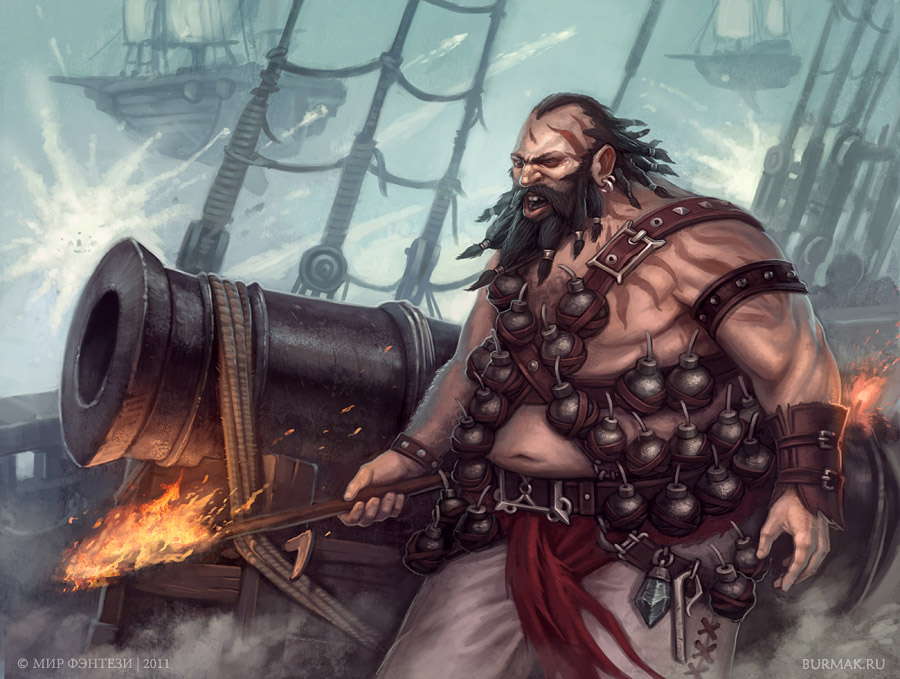
Cannoneer by DevBurmak

Requirements - Intelligence and Dexterity 9+

Armour Allowed - Padded, leather, ring mail, scale mail, tower shield/pavises

Weapons Allowed - All black powder and siege weapons, club, dagger, mace, polearms, shortsword, sling

Skills - Bend Bars, Break Down Doors, Engineering, Move Silently, Riding

Black powder isn't exactly new, but it is the cutting edge of technology. The Artillerist rides that edge, a master alchemist and pyromaniac extraordinaire. While they can fight, they prefer to hang back, using their fancy new weapons whenever possible.

When using black powder weapons, the Artillerist reduces their reload time to 4/6, or 1 round when using pistols. They can also use weapons which require a staff or support without one.

Masters of black powder and alchemy, the Artillerist can concoct small explosives in their downtime. Each takes 10 minutes to make, and the artillerist suffers no chance of failure (basic or explosive!) when making them.

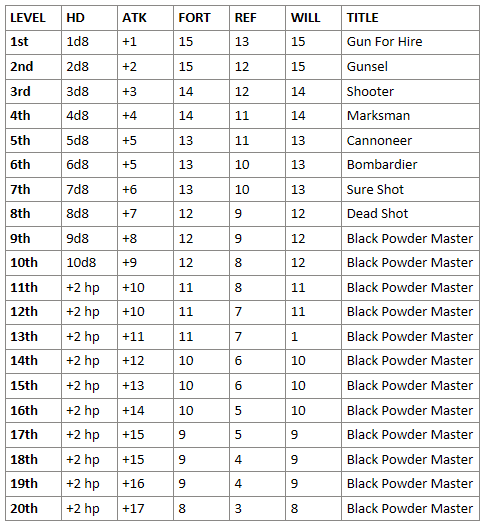
A 1st Level Artillerist can concoct normal explosives that become more powerful as they increase in level, and can create different concoctions as the table below;


All these bombs have a blast radius of 5 feet, or as their listed spell. An Artillerist can sacrifice one dice of damage to increase the radius by 10ft.

At 5th level, the Artillerist counts as two people when operating any siege or artillery weapons, and can reroll any artillery or thrown weapon scatter dice.

At 9th level, the Artillerist can open a Gunnery School, teaching the arts of black powder. They attract 1d6 men-at-arms per level, 1d6 1st level artillerists who wish to train under them, and a 3rd level artillerist to act as a lieutenant/deputy headmaster.


The Topkick is a master of small-unit tactics; the one leading boats on shore missions, or groups to infiltrate a coastal fort to bring it down from the inside. Similar to a Captain being in charge for shipboard battles, the Topkick is the absolute authority on his missions. This does not mean he cannot be questioned, but simply that his fellows trust his word when it comes to tactics.

This version of the Topkick is heavily lifted from A Wizard's Kiss, who did a version of the Warlord for OSR games. While he hasn't updated for a while, his blog is full of cool stuff - go have a look!

THE TOPKICK

Captain Flint is a Topkick for sure
Requirements - Intelligence and Charisma 13+, Strength 9+

Armour Allowed - All

Weapons Allowed - All

Skills - Communication, Politicking, Riding

Topkicks demand absolute dedication from their allies in battle. This doesn't mean the other players have to obey everything the Topkick tells them to do, it just means that when the Topkick says jump, your character trusts him enough to know that there must be a knee-high buzzsaw approaching or suchlike.

To establish this trust, the Topkick must spend ten minutes talking to any new party members. There cannot be more than one Topkick in a party - if there are, then their orders confuse each other and the Topkicks' abilities are all negated. The Topkick cannot command a group of people larger than the Topkick's Charisma score (until 9th level - see below.)

Topkicks can spend a standard action to use a Command, which is a catch-all term for various speeches, orders, battle-cries, etc. that have the power to turn the tide of battle. The Topkick can use one Command per level per encounter - the focus required for this sort of tactical thinking and charismatic oration is very mentally draining.

Commands only work on allies who are conscious and can understand the Topkick. They also need to be within 30' or the command is too faint or garbled to be heard.

Pick one Command at 1st level and one other at each odd-numbered level thereafter:

Encouraging Command: The Topkick and any allies under their command gain +1 to their side's Initiative rolls. 6th Level: +2 to initiative rolls.

Defensive Command: The Topkick can gather their allies into a shield wall - if three or more are together and armed with shield, they can an extra +1 AC, and provide cover to anyone behind them. 6th Level: gain +2 AC in the shield wall.

Invigorating Command: The Topkick inspires one ally to fight on through the pain, giving them 1d6 temporary hit points (last until the end of the encounter or 1 turn). 6th Level: 1d6+level hitpoints, and if the ally is unconscious, you can use this to slap them awake.

Inspiring Command: The Topkick brings one ally back from the brink of terror and defeat, allowing them to reroll a failed morale check or saving throw vs. fear. This command can be used as a reaction (i.e. on the turn of the person failing the save or morale check.) 6th level: Can grant all allies a rerolled morale check, OR grant one ally a rerolled save against domination, confusion, or other mental effects.

Warning Command: The Topkick warns one ally of an incoming attack, granting them a +4 bonus to AC for one round against the next attack from a designated enemy. 6th level: The Topkick predicts every attack just before it happens, granting the bonus against all incoming attacks in the next round.

Analysing Command: The Topkick points out a weak spot in the enemy's armour or their posture, allowing one ally to gain a +2 bonus to hit and damage against that enemy on their next attack. 6th level: All allies gain the bonus against that enemy for one round.

Tactical Command: The Topkick sees an opening in the flow of battle and orders one ally into it, granting them an extra action. 6th level: This Command, and the extra action it grants, can be used before initiative is rolled.

At 9th level, the Topkick gains the ability to command an army of up to 100 soldiers per level, or one ship per level. Everyone in the army is considered to be an ally for the purposes of Commands, though the effects will still be limited by the 30' radius. Furthermore, the Topkick's Commands can now also be used as Gambits - essentially the same thing but on a Naval scale. For example, a Tactical Gambit could be used to steal a ship into an enemy formation, an Analysing Gambit could maneuver a ship into position to flank, etc. DM fiat/negotiation will be required here, as it isn't a perfect fit with the Freebooters Naval Combat rules, but I am sure I can make it work!

Thursday, 3 March 2022

Gygax 75 Challenge - Week 3: The Dungeon

So, we return with the next part of the Gygax 75 Challenge - making a campaign setting from scratch over 5 weeks.

Introduction

Week 1 - The Concept

Week 2 - The Surrounding Area

The third section is the "main event" - The Dungeon! The first big challenge for a new group of players to tackle. It's got to take planning, logistics, and most importantly luck to truly conquer.

Remember, you can play along at home - visit Ray Otus' itch.io store and download the workbook (for free!) to get started!

Thursday, 24 February 2022

Gygax 75 Challenge - Week 2: Surrounding Area

So, we return with the next part of the Gygax 75 Challenge - making a campaign setting from scratch over 5 weeks.

Intro

Part 1

The second section is about creating "the surrounding area", the starter point for the game - launching point of (hopefully) many years of adventures!

Remember, you can play along at home - visit Ray Otus' itch.io store and download the workbook (for free!) to get started!

Thursday, 17 February 2022

Gygax 75 Challenge - Week 1: The Concept

So, Week 1 begins!

I have am easy start here, because I already have most of the concept in mind. I want D&D Does Pirates, rather than just a lightly-reskinned D&D game. The setting becomes an important part of that - it needs to be alive and vibrant, offering more opportunities than just dungeons.

Of course, there will be dungeons, I'm not a monster.

Remember, you can play along at home - visit Ray Otus' itch.io store and download the workbook (for free!) to get started!

Wednesday, 16 February 2022

Gygax 75 Challenge - Make A Campaign Setting in 5 Weeks!

So, it's been... a while since I have posted here. Things have been up and down, lots going on, but here's hoping I can make this time stick. I have been pushing myself to be a little more creative, as I feel that a lack of any creative output has really caused some issues in my life.

To help with that, I am going to give the Gygax 75 Challenge a go - see if I can use it to make a campaign setting in 5 weeks. Specifically, I am going to work up a setting for a long-in-the-tooth back burner project; an OSR Wavecrawl/Saltbox Pirates game.

Each week, I will post up what I have managed, and by the end of it, we will see what I have managed to make. Hopefully, this will end with a wonderfully weird and interesting place to run a few games.

You can even follow along at home - visit Ray Otus' itch.io store and download the workbook!

Monday, 15 October 2018

War Cults of the Southron Reaches Preview - The Bloodied Brotherhood

Another preview of War Cults, this time a full Cult! Ares is a fairly typical God of War, but the real fun comes from dealing with the fallout from having his Cult in your town...

Ares is the God of War, Bloodshed and Violence. A Chaotic being of great mirth and deep, sullen depressions, He represents the chaos of the battlefield and the subjugation of enemies. His worship is somewhat limited – his Chaotic aspects don’t tend to attract much respect outside of wartime.

His followers are a violent lot – more interested in strength of arms and the rush of battle than anything else, even their own safety. The rites and rituals of the cult are often linked with bacchanalian drinking sprees, bloodsports and animal baiting. Those cities which host full-time Ares Cultists accept their presence with a grimace – while they are known for their excesses and property damage, they are also fantastic when the city requires defence, or to create a sense of security during times of unrest.

The warriors recruited by Ares’ Cult are normally at peak physical strength – able to use weapons as tall as they are with ease, and take blows that would outright kill lesser men. In some of the City-States of the Southron Reaches, children as young as three are chosen from suitable parents and inducted into the Cult to be trained as warriors. They undergo intense physical training and religious indoctrination to make them the perfect servants of the Bloodied God.

Many warlike humanoids (mainly orcs and hobgoblins) will create altars to Ares after encountering his Cultists, and humanoid priests of the Bloodied God are not uncommon. And indeed, any blood shed in his name grants some measure of power – while rare, there are a few full-blown Clerics of Ares amongst the Orcish tribes of the Firgian Wastes.

Rites
Ares calls for his followers to be ready for battle at all times, and his Rites reflect that. He has no set days of worship, nor times dedicated to him – the chaos of battle can strike at any moment.

Bloodsports – the Bloodied Brotherhood takes part in ritualised fights to first blood between members. These fights can have a number of stipulations, ranging from specialised weapons (cestuses, short swords and clubs are popular options), styles (pankration, blind-fighting and with certain limbs bound) and specific win conditions (first to hit the floor, first to make a sound, last man standing), between anywhere from two to a dozen combatants. Casualties and deaths are frequent, but healing magic goes a long way to making sure they are able to continue to serve the Cult. These bloodsports are also used as a form of trial and execution for crimes against the Cult – fighting to the death. If the accused survives, they are allowed back into the fold, their crimes forgiven – Ares clearly holds them in high regard.

Bloodletting – for those members of the Cult who are considered extreme even by the low standards of the Bloodied Brotherhood, the Cult allows them to release some of their rage via controlled bloodletting. While in mad, drug-induced frenzies, the Cultist is tied to a sacrificial altar, made of dark polished stone with channels designed to collect any spilled blood. Symbols of Ares, conquered foes and other esoteric symbols are carved into the flesh of the Cultist, letting out their hot rage and excess blood. This blood is collected, to be painted onto the faces, bodies and weapons of other Cultists before battle to grant them the rage of their fellows.

Baiting – while the Cult used to perform animal sacrifices to Ares, they noticed He seemed more likely to grant them his favour when the animals were given a chance to fight back. Much like the bloodsports, these battles are either between a Cultist and a beast, or between beasts themselves. While some of these beasts are locally sourced (wolves bears, owlbears and giant vermin being favourites), the High Priests will occasionally pay for some more exotic fare for the Beast Pits.

Dramatis Personae

Xephos, Head Priest of Ares
Xephos is a giant of a man, standing seven feet tall, broad as a bear and muscled like a bull. Dark black ringlets run down to his shoulders, framing a face that looks like it might have been chisled from granite. Like many Southrons, he is frequently found nude – however, he is known for wearing the pelts of beasts he has slaughtered in the arena as headdresses and cloaks. He also maintains his nudeness even when socially unacceptable, such as during official events or political meetings. Of course, no-one calls him out on this, as his station means he could get away with slaying just about anyone with no repercussions.

Despite the scarred nature of his fellows, Xephos does not bear a single scar on his body. While some claim he uses magical healing to maintain this appearance, most assume it is from his prowess in battle.

Much like his God, he is a man of titanic mood swings – one moment in a deep melancholy for having no equal to battle, the next a crimson rage so deep as to terrify even his closest clergy, to being the happiest man in the room. He is truly unpredictable, and a truly terrifying enemy.

Deathdealer Mercenaries
The Bloodied Brotherhood are also famous for selling their services as mercenaries, to raise funds for the Cult and find new and creative ways to murder people for their God. Mostly, they are hired by the Southron City-States during skirmishes or as a defending force from external invasions, but some will sell their services to other kingdoms, even travelling far across the world to spread the word of Ares and earn both money and renown for themselves and their God. While these travelling mercenaries will wear leather armour to keep with local traditions, they will revel in any opportunity to remain nude as they would back home. Of course, this can make them somewhat notorious in some areas.

Plot Hooks
The weekly Beast Fights have gotten out of hand, and a creature has escaped to wreak havoc within the city!

The Pitmaster is looking for a new beast for the Beast Pits, and is offering top dollar for something interesting. While out drinking, you hear tales of a particularly mean old Owlbear nesting somewhere nearby…

Two recently-joined Acolytes of the Bloodied God have been causing trouble, throwing their weight around. A few concerned citizens have asked you to deal with them quietly and respectfully (no-one wants retribution from the Bloodied Brotherhood).

Recent attacks by humanoid tribes are being led by Orcish Clerics of Ares. Might the Cult be able to use their standing to begin parlay with the invaders, or even bring them on side?

Tuesday, 9 October 2018

War as Religion

So, during my hiatus from the blog, I have collected together a few ideas for future publishing projects. One is going by the working title "War Cults", and will detail a few sample religions based around conflict and war, as well as a micro-setting based on Ancient Greece by way of D&D. Here's a quick sample...

It’s a historical truism that religion reflects what a culture maintains as important, and vice-versa. Cultures which respect academia tend to have mystery cults, those who live closer to nature worship entities with intimate ties to the elements and the land, and those with expansionist tendencies tend to worship Gods who will help them conquer and expand. A common theme amongst such cultures were “Hero Gods” – regular men who, through their skill at arms or achievements in battle, became god-like figures in their own right, or mortals granted abilities through divine heritage. This brings human motivations, including nationalism, into the realm of Godly pursuits, further driving the idea of conquest into their culture.

Many polytheistic cultures held Gods and Goddesses of Strength, War and Battle in high esteem – soldiers directly worshiped them, while those who never saw battle still sent prayers during both times of war and during peacetime. They held many different domains – from those specific to Bloodshed and Battle, to Tactics, to defending the homestead. However, the sheer act of deifying these aspects shows the ways they can be used in a day-to-day context – asking for strength, quick-wittedness or bravery in many contexts.

But, during times of war, these Gods take the centre stage. One can even see these wars as the worldly representation of battles in Heaven – God versus God, pushing to weaken the other through defilement of places of worship and subjugation of worshipers. Many of these cultures would outlaw the religions of conquered cultures, solidifying the idea that “their Gods won”, while others incorporate them into the conqueror’s mythos, creating a larger pantheon from which to draw upon.
Even in monotheistic faiths, there are often aspects of the main deity which impart similar strengths – from patron saints of soldiers, to direct divine intervention during times of war. Religion becomes not only a support for war, but quite often a catalyst.

In fantasy, this tendency becomes even more pronounced – rather than true polytheism, servants of Gods choose one to worship above all, and those who choose Gods of War tend towards a more militant stance, making them excellent characters with strong motivations.

Of course, one might also note that in many fantasy settings, gods with warfare-based domains also double as the gods of non-human races (Orc Gods are often saddled with this dual nature). This tends to push them towards expansionist tendencies, violent actions, and generally puts them straight into the antagonist camp.


(The morality of human expansionism being something to strive for, and non-human expansionism being outright Evil, is best left as an exercise for the reader).


Wednesday, 12 October 2016

We Be Goblins! Remix Edition

So, I got a hankering to run We Be Goblins as a fun way to get the ball rolling again with my old group. However, reading through it and the three followup/prequel modules, I wasn't as massively taken with them as I remember.

For a module series focused on a fun, anarchic experience, the Pathfinder rules are a terrible fit. Too chunky, not enough leeway, more concerned with simulationism than fun.

Even the non-mechanical assumptions are pretty jarring - there's a whole tribe of goblins looking to score some fireworks, but only 4 of them get to do anything? You're a rag-tag group of the lowest rung of the humanoid ladder, but you're organised into a perfect Fighter-Thief-Cleric-Alchemist combo? You get to compete for magic items the tribe just has laying around?

There's a lot of small things that feel a little off with the modules, so here's the way I want to try it:
  • Goblins are the lowest of the low. They roll their stats with 3d6, and have all the usual Goblin traits. Goblins don't get the usual Pathfinder Feats or Traits, and have no Class. 
    • (It's a stolen joke, but it's a classic)
  • They start with 1d4 HP, modded by Constitution.
  • Each player also gets two pre-gen backup Goblins, cause this is gonna be a deadly one.
  • Goblins are a chaotic, ramshackle lot - each Goblin has to roll for a Name, Trinket, Lucky Frog and Trait on the following tables:
Roll
Name
Trinket
Lucky Frog
1-2
Addur
A single, half-soggy firework
Spotol
3-4
Aka
A bag of salted slugs
Fat Frog
5-6
Boorgub
Hand-sized spider in a cage (named Stankrush)
Dogfinder
7-8
Chee
Jar of pickled halfling toes just about ready for eating
Amfibier
9-10
Chuffy
Halfling-sized toasting fork
Splat
11-12
Churkus
20 feet of rope with dead moles sewn into it
Bitey
13-14
Drubbus
Small silver hand mirror, in surprisingly good condition
Froggy McFrogface
15-16
Fevva
Jar of Dwarven perfume (half drunk)
Squish
17-18
Gawg
Rusty meat hook (1d4 dmg)
Bugeater
19-20
Geedra
Flint and tinder
Gump
21-22
Ghorg
Human-sized bridal veil
Shitter
23-24
Gogmurch
Halfling ladies’ corset (AC+1)
Stink
25-26
Goomluga
3 metal skewers (1d3 dmg, throwable)
Pigface
27-28
Gretcha
Stuffed raven
Really Fat Frog
29-30
Hibby
Bottle of brine-soaked alligator eyes
Barbar
31-32
Hoglob
Child’s doll with the eyes taken out
Lord Frogington
33-34
Ikky
Grappling hook
Actually a Toad
35-36
Irnk
3 tindertwigs
Boggy
37-38
Janka
Cowbell (worn)
Smokey
39-40
Jurk
Homemade Thieves' Tools
Munchmunch
41-42
Kavak
Squashed dried toad (his previous lucky pet toad)
Cobblers
43-44
Klongy
Jar of pickled fish heads
Kick
45-46
Luckums
6 Goblintallow torches
Bubbles
47-48
Lunthus
Almost empty salt shaker
Bip
49-50
Lupi
Pig’s tail jerky
Stabber
51-52
Medge
Wooden flute (too splintery to play without injury)
Mad Dug
53-54
Mogawg
Gourd of pickled leeches just about ready to eat
Horsesniffer
55-56
Mogmurch
Skull face mask (+1 AC, fragile)
Shagrat
57-58
Murch
Juicy slug in a small pot
Dunk
59-60
Namby
Metal codpiece, anatomically correct (+1AC)
Goose
61-62
Nurpus
Heavily-soiled Human-sized Jester’s hat
Spits
63-64
Olba
Pumpkin-head lantern
Warty
65-66
Ooft
Black eyepatch (with hole cut in it to see)
Blob
67-68
Pogus
Hard leather boot (used as belt pouch)
Windy
69-70
Poog
Bag of incredibly weevil-infested flour
FIRETOAD
71-72
Rempy
Ancestral dogslicer, stolen (1d6 dmg)
Hairy
73-74
Reta
A very thick piece of charcoal
Jarp
75-76
Ronk
A stick. It's very sharp. (1d4 dmg)
Looky Lou
77-78
Ruxi
A bag of spotted blue mushrooms (DC11 Fort save or 1d6 Int dmg and hallucinations)
Sticky
79-80
Rotfoot
Lucky charm necklace made of Halfling ears
Slipper-Slide
81-82
Scroff
Large wooden spoon (1d3 dmg)
Smudge
83-84
Sweetums
Stone skinning knife (1d4 dmg, fragile)
Bonk
85-86
Unk
3 dead rats
Maggiepie
87-88
Urub
Metal brazier torch (1d4 dmg plus fire)
Plop
89-90
Vogun
Brass trumpet (well out of tune)
Parp
91-92
Vruta
Rattleshirt of small animal bones (+1 AC)
Lurky
93-94
Yalla
RICHES (1gp)
Egg
95-96
Ziku
Jar of goblin urine, well aged (causes sickness)
Snoopy
97-98
Zobmaggle
Halfling-sized powdered wig
Wakka
99-100
Zord
Human-sized wand (1d3 charges of a random 1st level spell)
Soggy

Roll
Trait
1-4
Dog-Sniff-Hate - you gain Scent, but only for dogs and dog-like creatures.
5-8
Balloon-Headed - your head is way too big. +1 to Perception
9-12
DOG PUNCHER - +1 to hit and +2 damage vs dogs
13-16
Pustular - you got the Pox. Advantage on Fort saves vs Sickening/Nausea
17-20
Goblin Stupidity - gain +1 to hit when fighting foes larger than you.
21-24
Goblin Bravery - first to run, last to die. +2 to Initiative
25-28
Bouncy - your bones are rubbery. Falls count as 10' shorter.
29-32
Ankle Biter - your teeth are sharp. Gain a bite attack (1d4 dmg)
33-36
Ugly - you are hideously scarred. +2 to Intimidate
37-40
Pyromaniac - you're used to getting set on fire. It is not your friend. Gain Fire Resistance 2.
41-44
Rager - you were born with a tiny, green fury in your heart. Gain Rage as a 1st-lvl Barbarian, but you can't tell friend from foe.
44-48
BURN BURN BURN - you love fire. Fire is your only friend. You do 1d4 extra damage with fire.
49-52
Easy Rider - you know just the right chokeholds to stay on a mount. +2 to Ride
53-56
Coward - you know just how to get out of fights. +4 to initiative, but you must pass a DC13 Will Save to get into combat in the first place.
57-60
Oversized - you're a biggun! +2 Str, Medium size
61-64
Headcase - you're insane, even by Goblin standards. Gain +2 vs mental effects
65-68
Shaman's Apprentice - you studied under the Tribe's magic-user. You learn 3 0-lvl Adept spells, castable 3/day each
69-72
Smartarse - you have more brainpower than the average Goblin. +2 Int
73-76
Sarge - you were born to lead. +2 Cha
77-80
Tough - as old leather boots! +2 Con
81-84
Sweaty - you constantly ooze. +2 to Escape Artist
85-88
Tinkerer - you're always fiddling with something. +2 Craft (any)
89-92
Runt - you were the smallest of the litter. -2 Str, +2 Dex
93-96
Colour Thief - your skin is oddly chameleonic. +2 to Stealth.
97-100
Backstabber - if you manage to sneak up on someone, you score double damage on all attacks they don’t expect.

Once you've made your Goblins, it's time to face the horrors...

Next time, I'll show my mashup of the best bits of the modules into one big chaotic mess - just right for Goblins!